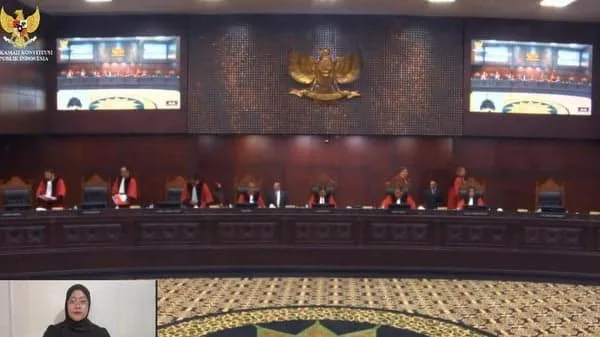
Jakarta, Legal Literacy - The Constitutional Court (MK) concluded that the parliamentary threshold of 4% of the national valid votes, regulated in Law Number 7 of 2017 concerning General Elections (Election Law), contradicts the principles of people's sovereignty, electoral justice, and violates the legal certainty guaranteed by the constitution.
Therefore, the threshold was considered constitutional in the 2024 DPR Election, but will be considered conditionally constitutional in the 2029 DPR Election and onwards.


This decision was announced in the Constitutional Court's Decision Pronouncement Hearing on Thursday (29/2/2024). Perludem, in its petition, questioned the provision related to the proportional electoral system.
The Court stated that there is no adequate basis for setting the parliamentary threshold, including in Article 414 paragraph (1) of the Election Law, and found no rationality in determining the amount or percentage according to the legislators' explanation.
Disproportionality Occurred
In addition, Saldi emphasized that the parliamentary threshold significantly affects the transformation of valid votes into DPR seats, which is relevant to the proportionality of election results. In other words, in the context of a proportional electoral system, the votes obtained by a political party should align with the number of seats they obtain in parliament to maintain proportional election results. Therefore, in a proportional electoral system, it is important to minimize wasted votes to maintain proportional election results.
In the context of fulfilling the principle of proportionality in legal considerations, the Court noted that in the 2004 Election, approximately 18% of valid votes, or 19,047,481 votes, could not be converted into seats. In the 2019 Election, approximately 9.7% of valid votes, or 13,595,842 votes, suffered a similar fate. Although in the 2014 Election only about 2.4% of valid votes, or 2,964,975 votes, could not be converted into DPR seats, the number of political parties in the DPR was factually higher, namely 10 political parties, compared to the results of the 2009 and 2019 Elections.
Saldi pointed out that the empirical data confirms the disproportionality between voters' votes and the number of political parties in the DPR when the parliamentary threshold is applied in the election of DPR members. This indicates that the constitutional rights of voters become meaningless or ignored due to efforts to simplify the party structure to create a strong presidential system, supported by an efficient representative institution.
“In fact, the principle of democracy places the people as the owners of sovereignty as referred to in Article 1 paragraph (2) of the 1945 Constitution, but the parliamentary threshold policy has apparently reduced the rights of the people as voters. The people's right to be elected is also reduced when they get more votes but do not become members of the DPR because their party does not reach the parliamentary threshold,” said Saldi.






















Write a comment