

Legal Literacy - On Wednesday, March 15, 2023, the Constitutional Court will hold a plenary meeting of judges to elect the chairperson and vice-chairperson. The election will be conducted in two stages, starting at 11:00 AM WIB.
The Constitutional Court will conduct the election of the chairperson and vice-chairperson for the next five-year term. Although all constitutional judges have the same right to become chairperson, two constitutional judges are believed to be competing fiercely in the election, namely Anwar Usman, who currently serves as chairperson, and Arief Hidayat, who previously also served as chairperson. The election of the chairperson and vice-chairperson will be held in a plenary meeting of judges on Wednesday, March 15, 2023, at 11:00 AM WIB.


Two Stages in the Election Process of the Chairperson and Vice-Chairperson of the Constitutional Court
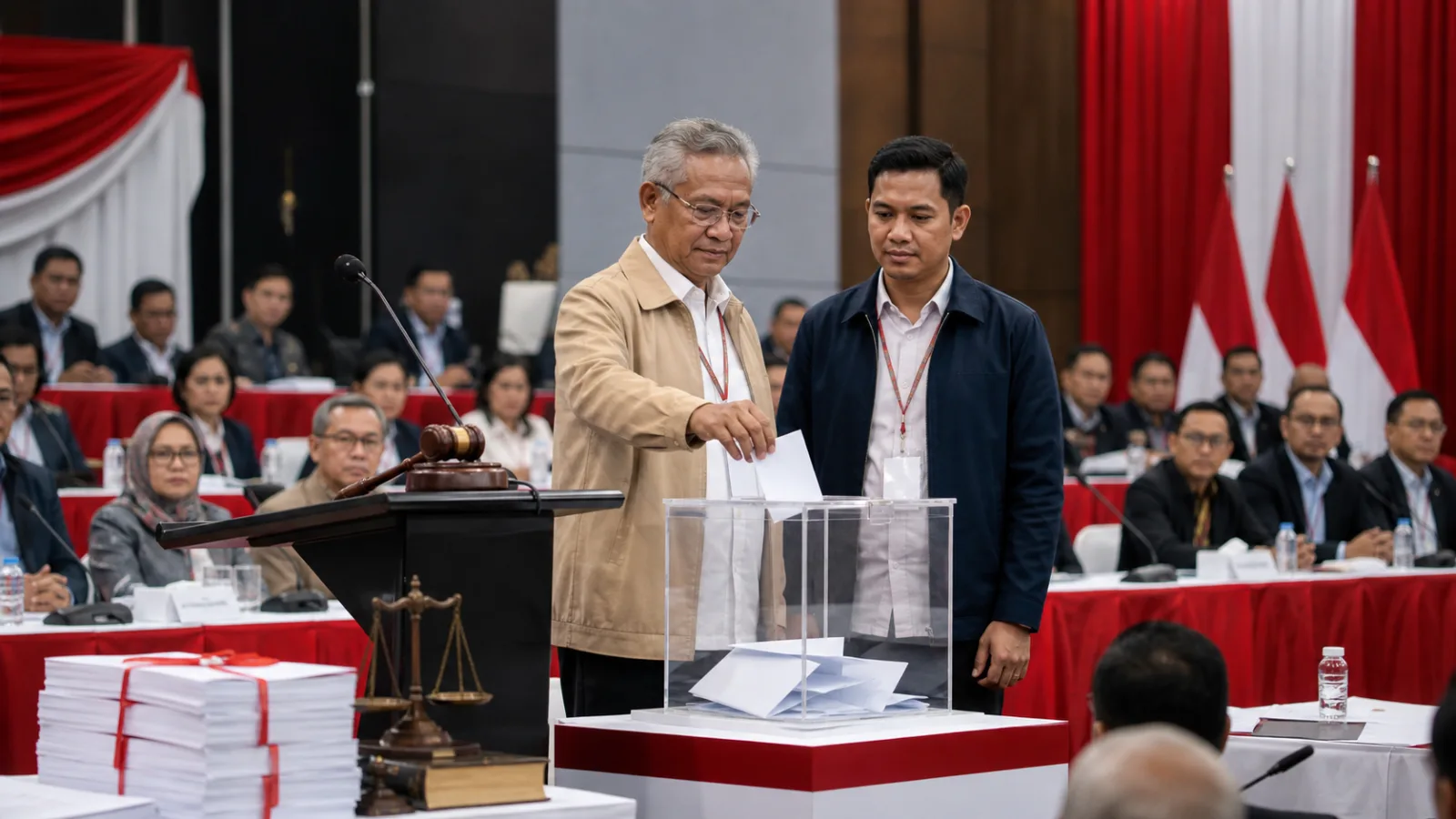
According to a press release issued by the Constitutional Court on Tuesday, March 14, the election will be conducted in two stages. The first stage will be conducted through deliberation to reach a consensus among the nine judges. If no agreement is reached, the election will be conducted through an open vote in the main courtroom of the Constitutional Court Building, Jakarta.
After being elected, the chairperson and vice-chairperson will take an oath in a special plenary session of the Constitutional Court to be held on Monday, March 20. The Constitutional Court also invited the President/Vice President, heads of state institutions, ministers, and other officials to attend the event.
According to information, Anwar and Arief have almost the same number of voters; both are equally strong. The lobbying process among constitutional judges occurred until the day of the election. Enny Nurbaningsih, spokesperson for the Constitutional Court, denied the existence of such lobbying processes when confirmed. She said that no judges contacted her to ask for support because they realized the importance of maintaining the independence of the Constitutional Court's Ethics Council (MKMK). Enny also explained that she is currently focusing on her duties at the MKMK, and when she met with Anwar and Arief, they only coordinated regarding cases and panel replacements because she was in session at the MKMK.
Heavy Duties and Challenges of the Elected Chairperson
Both candidates have received public attention with different records. Anwar, as the brother-in-law of President Joko Widodo, makes some people worry that it will affect his independence as a judge and chairperson of the Constitutional Court. On the other hand, Arief Hidayat was once subject to a light ethical sanction by the Ethics Council.
According to Charles Simabura, an expert in constitutional law from Andalas University Padang, the public does not have many choices but to hope that both candidates can open a new chapter if elected as leaders of the Constitutional Court. "If entrusted to lead the Constitutional Court, they must restore personal dignity by demonstrating independence and improving the image of the institution. Although the Constitutional Court is a collective collegial institution, they represent the image of the institution," he said.
Anwar and Arief are expected to provide a good legacy by improving the image of the Constitutional Court and reaffirming its position as the "guardian of the constitution". "Change the image, become someone who returns to their true identity, become a statesman," added Charles.
Both candidates have until 2026 to serve as constitutional judges. Anwar will complete his 15-year term in that year, while Arief Hidayat will reach the retirement age of 70.
Charles suggested that the constitutional judges consider the various challenges that the Constitutional Court will face in the future when choosing the leadership of the Constitutional Court. These challenges include simultaneous elections, controversial regulations such as the Government Regulation in Lieu of Law on Job Creation, the Criminal Code, the state capital, and regulations related to natural resources that will be debated.
According to Charles, the biggest thing to maintain this year and next year is democracy, including the space to question changes to the 1945 Constitution, the extension of the term of office of the president and vice president, and the postponement of elections. Therefore, the new leaders of the Constitutional Court must be statesmen who are able to stand above group interests.
The future leaders of the Constitutional Court are also expected to side with the public, even though the pressure on the institution and the judges themselves is increasingly real. There is a plan to revise the Constitutional Court Law which introduces a five-yearly evaluation of Constitutional Court judges by the proposing institution, but the leaders of the Constitutional Court are expected to uphold the independence and integrity of the judges.
Source:
Kompas.id

















Comments
0Share your perspective politely, stay relevant, and focus on the article. Comments appear after moderation.
Join the discussion
Write a clear, polite response that stays on topic.
No comments yet. Be the first to discuss.
Comments will appear after moderation.