
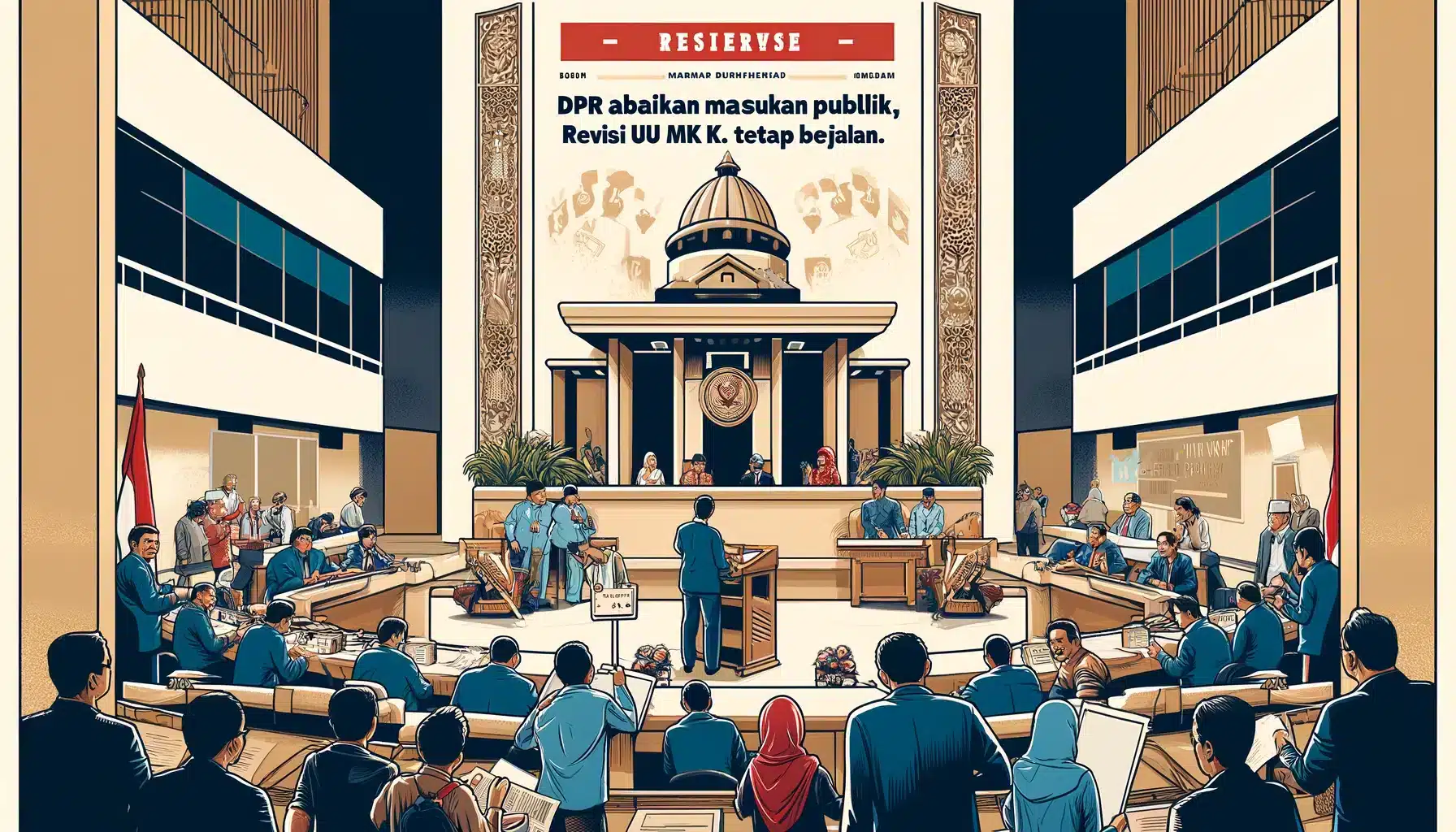
JAKARTA, LEGAL LITERACY — The House of Representatives (DPR) is determined to pass the Bill on the Constitutional Court (RUU MK) into law in the nearest plenary session. This decision continues despite criticism from the public who suspect an attempt to weaken the MK.
Member of Commission III of the DPR from the Democratic Party Faction, Santoso, stated that all political party factions in parliament have agreed on the substance of the Bill MK since November 2023. Last week's discussion was only to complete level I by listening to the views of the government.


"It has not been ratified, just waiting for the plenary session. The discussion has been completed since November 2023, not suddenly. Last week was only to complete level I," said Santoso on Thursday (16/5/2024).
Santoso denied allegations that the discussion was conducted behind closed doors without inviting certain political parties. According to him, all processes have been according to procedure and no political parties were not invited.
In the preparation of the MK Bill, Santoso claimed to have listened to public opinion. Public criticism is considered a normal dynamic of democracy, and the most important thing is that the law-making procedure has been followed.
"All laws must have pros and cons. This is normal in a democracy. The important thing is that the procedure is correct," he added.
Santoso also denied that the MK Bill is laden with certain political interests. According to him, the DPR only wants to evaluate constitutional judges so that the MK institution is better.
Chairman of the National Mandate Party (PAN) Faction of Commission III of the DPR, Sarifuddin Sudding, added that the MK Bill actually provides an opportunity for career judges with good track records to become constitutional judges.
No faction rejected the level I decision on the MK Bill. All factions have agreed on the substance of the Bill, so there is nothing more to question.
Deputy Chairman of the DPR from the Gerindra Party Faction, Sufmi Dasco Ahmad, emphasized that the DPR only needs to pass the MK Bill in a plenary session after obtaining first-level approval.
Dasco explained that discussions during the recess period are allowed as long as there is permission from the DPR leadership, and that permission has been granted.

















Comments
0Share your perspective politely, stay relevant, and focus on the article. Comments appear after moderation.
Join the discussion
Write a clear, polite response that stays on topic.
No comments yet. Be the first to discuss.
Comments will appear after moderation.