
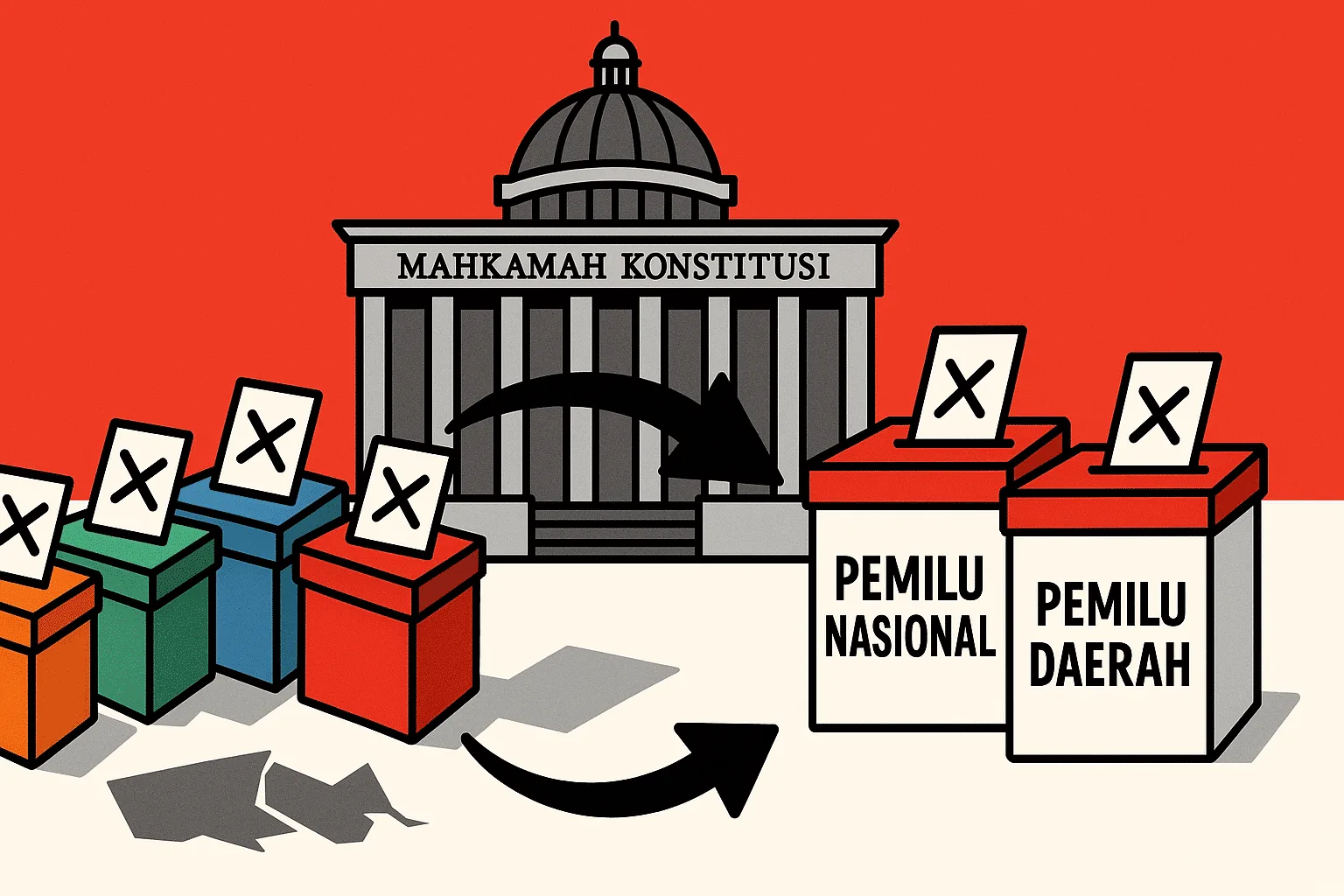
Jakarta, literasihukum.com – The Constitutional Court (MK) has officially changed the election administration system in Indonesia by separating national and regional level elections. Through a ruling read out on Thursday (26/6/2025), the Constitutional Court stipulated that the simultaneous five-ballot box election model would no longer apply from 2029.
The decision, which partially granted the application from the Association for Elections and Democracy (Perludem), formulates a new model for simultaneous elections. Later, general elections to elect members of the DPR, DPD, as well as the President and Vice President (National Elections) will be held first. Then, voting to elect members of the Provincial/Regency/City DPRD and Regional Heads (Governors, Regents and Mayors) will be held at one time (Regional Elections) with a time span of at least two years and a maximum of two and a half years after the inauguration of national-level officials.


In its legal considerations, the Court outlined a number of fundamental reasons behind this crucial change. One of the main highlights is the heavy burden borne by voters and organizers. According to Deputy Chief Justice of the Constitutional Court, Saldi Isra, the five-box system makes voters saturated and unfocused because they have to make choices between too many candidates in a limited time. "This condition, whether realized or not, leads to a decline in the quality of the implementation of people's sovereignty in general elections," said Saldi.
In addition, the Court assessed that the holding of simultaneous legislative and presidential elections with DPRD elections caused regional development issues to be ignored. Public and media focus tends to be absorbed by national political issues, so important agendas at the provincial and regency/city levels do not receive due attention. This separation is expected to restore public focus on the quality of candidates and programs offered at each level.
Another negative impact of the previous system, according to Constitutional Justice Arief Hidayat, is the weakening of political party institutions. The overly tight schedule forces political parties to get caught up in pragmatism, such as recruiting candidates based solely on popularity for momentary electoral interests, rather than carrying out ideological cadreization. "Recruitment for political positions in general elections opens up wide opportunities based on transactional characteristics," explained Arief.
As a follow-up to decision number 135/PUU-XXII/2024 The Constitutional Court has handed over the authority to regulate the transition period to the legislators, namely the DPR and the Government. This arrangement is necessary to align the terms of office of DPRD members and regional heads resulting from the 2024 Election in order to align with the new model election schedule which will begin in 2029.

















Comments
0Share your perspective politely, stay relevant, and focus on the article. Comments appear after moderation.
Join the discussion
Write a clear, polite response that stays on topic.
No comments yet. Be the first to discuss.
Comments will appear after moderation.