

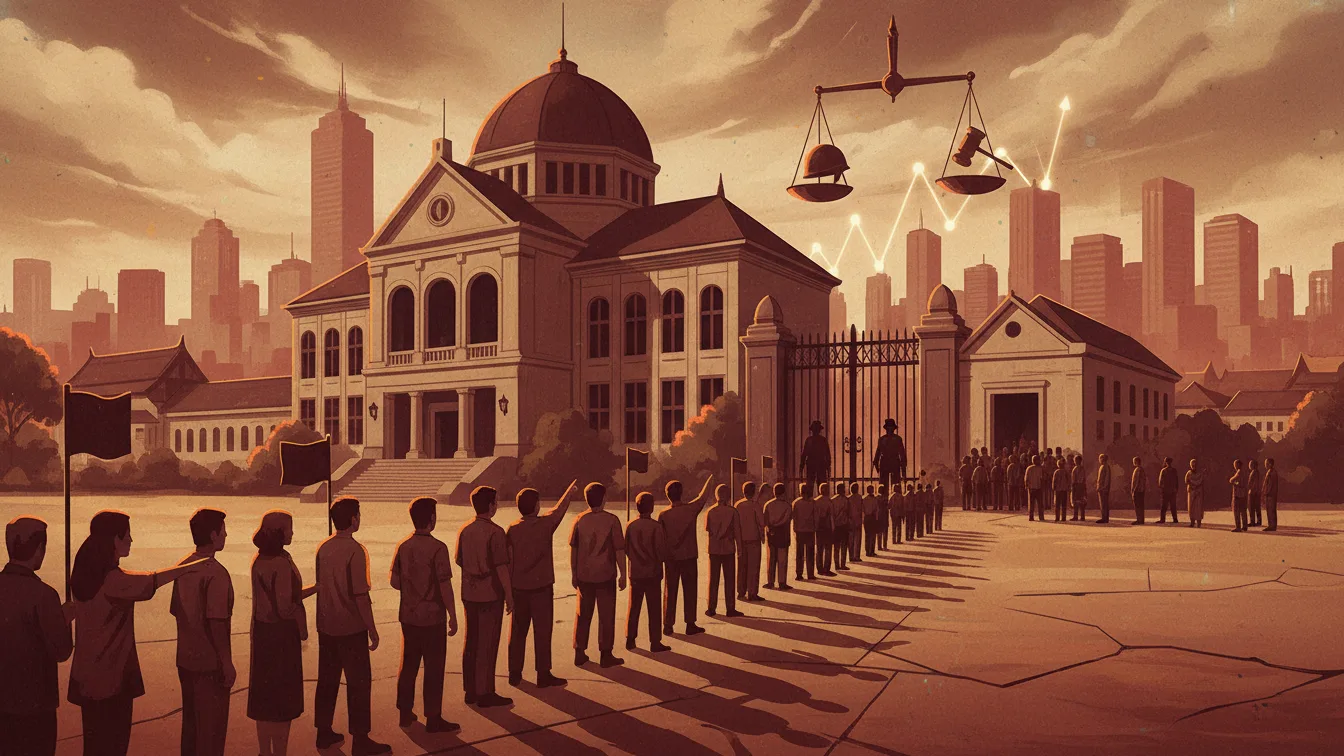
Legal Literacy — Following the United States military operation that led to the arrest of Venezuelan President Nicolás Maduro, the atmosphere in many Venezuelan cities turned grim. A number of residents described their neighborhoods as feeling “empty” and unusual, with public activity drastically decreasing and people choosing to stay home out of concern for further developments.
In some areas, road conditions were reported to be quieter than normal days. In shops, residents were seen buying more food and medicine supplies, while discussing possible scenarios that would occur. Although some people have been dissatisfied with Maduro's leadership, they tend to restrain themselves and not express their joy openly.


US Operation and Maduro's Arrest
The US launched an attack on Caracas and a number of other points in the early hours of Saturday, January 3, 2026 local time. The operation coded “Absolute Resolve” (in Indonesian news also referred to as “Operasi Tekad Bulat”) lasted several hours and ended with Maduro's arrest by US special forces. Maduro and his wife, Cilia Flores, were then flown to New York to be detained and prosecuted.[1]
Delcy Rodríguez appears as interim president, but refuses to cooperate
Amid a leadership vacuum that sparked widespread speculation, Vice President Delcy Rodríguez emerged as the figure controlling the interim government with the support of security institutions. Several reports stated that the appointment and temporary legitimacy were supported by state institutions and government elites who had been in Maduro's circle of power. [2]
Rodríguez took a confrontational political position against Washington. He asserted that Maduro was still considered the only president, and stated that Venezuela would not submit to the domination of foreign powers.
This attitude is contrary to the message of US President Donald Trump who, after the operation, stated that the US would “manage” Venezuela temporarily to ensure a safe transition. Until now, detailed plans regarding the form of “management” have not been clearly described in public statements.















Comments
0Share your perspective politely, stay relevant, and focus on the article. Comments appear after moderation.
Join the discussion
Write a clear, polite response that stays on topic.
No comments yet. Be the first to discuss.
Comments will appear after moderation.