Jakarta, LiterasiHukum.com – The Constitutional Court (MK) is scheduled to deliver a verdict on five formal judicial review cases of Law Number 3 of 2025 concerning the Indonesian
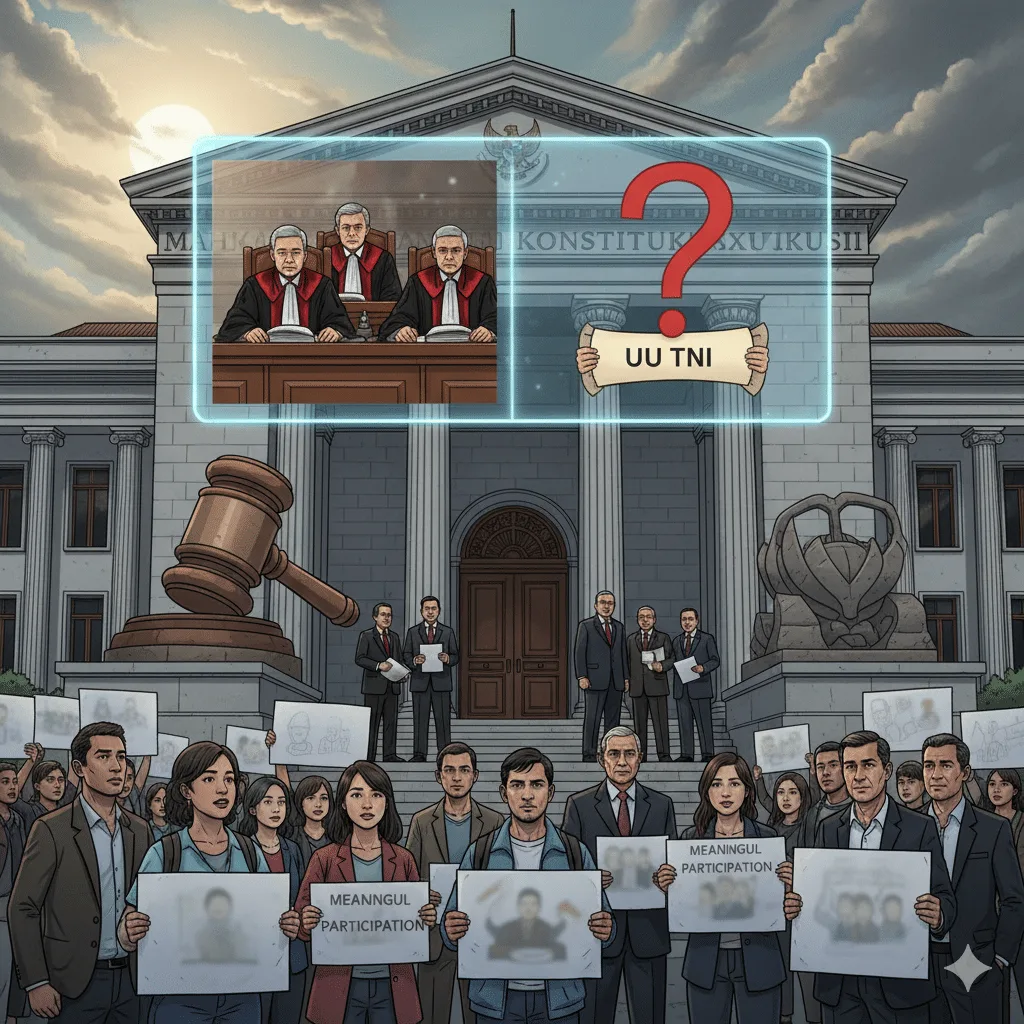
National Army (UU TNI) today, Wednesday (17/9/2025). This decision is the culmination of a series of trials testing the validity of the TNI Law formation process, with the main focus on the lack of meaningful public participation (
meaningful participation).
This lawsuit journey began with 10 applications submitted to the Constitutional Court. However, in its course, the Constitutional Court stated that five of them failed because the applicants, most of whom were students, were deemed not to have legal standing (
legal standing) to question the Law. Now, the fate of the controversial TNI Law is in the hands of nine constitutional judges.
The Battle of Legal Standing and Public Participation Arguments
At the hearing on June 5, 2025, the Constitutional Court emphasized that five applications were rejected because the applicants could not describe the specific and actual constitutional losses due to the formation of the TNI Law. According to the Constitutional Court, objections solely to the closed process are not sufficient to prove a causal relationship (
causal verband) between the formation of the Law and the applicant's losses.
Meanwhile, the five cases that passed to the evidentiary stage (Cases No. 81, 75, 69, 56, and 45/PUU-XXIII/2025) all argued that the legislative process of the TNI Law was formally flawed because it ignored the principle of meaningful public participation, as mandated by previous Constitutional Court decisions. The applicants, consisting of a coalition of civil society organizations such as YLBHI and Kontras, argued that the seemingly rushed and closed process had violated the constitutional rights of citizens.
Crucial Moment: Constitutional Judges Grill the Government and DPR
One of the most decisive moments in the trial occurred on June 23, 2025, when top state officials were present directly in the Constitutional Court courtroom. The presence of Chairman of Commission I of the DPR Utut Adianto, Minister of Law and Human Rights Supratman Andi Agtas, and Minister of Defense Sjafrie Sjamsoeddin was called "extraordinary" by Chief Justice of the Constitutional Court Suhartoyo.
In the hearing, the constitutional judges grilled the government and the DPR with sharp questions:
- Substance Broadening: Constitutional Justice Saldi Isra questioned why the revision of the TNI Law expanded to various issues outside the initial mandate of the previous Constitutional Court decision, which only related to the retirement age of soldiers.
- Proof of Public Participation: The judges demanded concrete evidence (minutes, photos, videos, even CCTV recordings) that could convince that meaningful public participation had truly been carried out, not just a formality.
The government and the DPR claimed to have opened up the widest possible space for participation through RDPU and working visits. However, this claim was denied by a witness from Kontras, Andrie Yunus, who stated that the letter requesting the draft law documents was never responded to, forcing them to interrupt a meeting at the Fairmont Hotel to get attention.
The Need for Clear Public Participation Guidelines
In the expert testimony hearing, an expert from PSHK, Fajri Nursyamsi, highlighted a systemic problem. He argued that the Constitutional Court (MK) needs to provide clearer guidelines regarding the implementation of three public rights in the legislative process: the right to be heard, the right to be considered, and the right to receive an explanation. Without binding guidelines from the MK, "reckless" legislative practices will continue to recur.
Fajri also sharply criticized the DPR's transparency.
"The DPR's website is incredibly sophisticated... but it's empty," he said, highlighting the failure to publish crucial legislative documents in a timely manner.
Today's Constitutional Court decision will not only determine the fate of the TNI Law, but will also become important jurisprudence for the future of democracy and the law-making process in Indonesia. This decision will test whether the Constitutional Court will truly become a guardian of the constitution by correcting flawed legislative processes, or whether it will legitimize practices that are far from public participation.
News Source: This article is the result of paraphrasing and analysis of news reported by Kompas.id on September 17, 2025.














Comments
0Share your perspective politely, stay relevant, and focus on the article. Comments appear after moderation.
Join the discussion
Write a clear, polite response that stays on topic.
No comments yet. Be the first to discuss.
Comments will appear after moderation.