

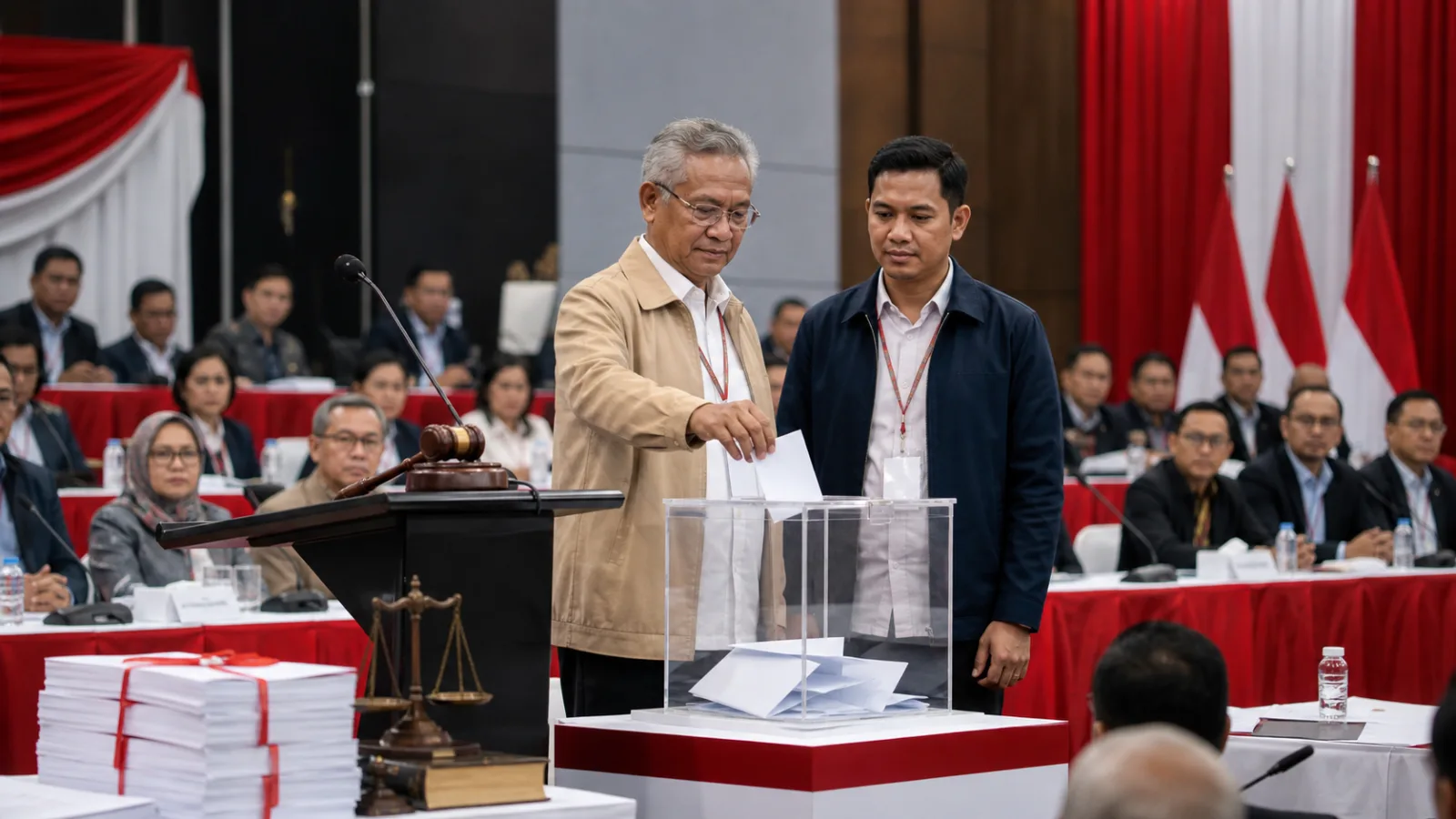
JAKARTA, LiterasiHukum.com — The Constitutional Court (MK) stated that the petitions of Applicant I and Applicant II cannot be accepted, and rejects the entire petition of Applicant III. This decision is stated in Decision Number 64/PUU-XXIII/2025 regarding the formal review of Law Number 1 of 2025 (third amendment to Law 19/2003 concerning State-Owned Enterprises) against the 1945 Constitution. The application was submitted by LKBH Mahasiswa Islam Cabang Jakarta Barat (Applicant I), Yayasan Citta Lokataru/Lokataru Foundation (Applicant II), and citizen Kusuma Al Rasyid Agdar Maulana Putra (Applicant III).
Public Participation Deemed Adequate
The Constitutional Court considers that the formation of Law 1/2025 has fulfilled the principles of transparency and meaningful participation. Constitutional Justice Ridwan Mansyur, when reading out the considerations on Wednesday (17/9/2025) in the Plenary Session Room of the Constitutional Court, stated that the Applicants' arguments regarding the absence of transparency and meaningful participation were groundless in law.


According to the Constitutional Court, the lawmakers have opened access to the public, gathered views from parties who understand the issues and are directly affected—including directors or representatives of SOEs—as well as academics and experts. The draft bill and academic paper are available on the official DPR website (puuekkukesra.dpr.go.id, SIMAS PUU menu), accompanied by a questionnaire for public input. The discussion process was also broadcast live via YouTube.
The Constitutional Court emphasized that opening public access is sufficient to prove the fulfillment of the principles of participation and transparency. Meanwhile, public input that is not fully accommodated into Law 1/2025 is the authority of the lawmakers, as long as its relevance has been considered.
However, the Constitutional Court encourages that in the future, lawmakers always listen to and prioritize the input of stakeholders as substantive considerations, so that the resulting laws meet the needs of the community.
Regarding Closed Meetings in the DPR
Responding to the argument that there were closed-door meetings discussing the bill, the Constitutional Court referred to Article 229 of Law 17/2014 concerning the MPR, DPR, DPD, and DPRD and DPR RI Regulation 1/2020 concerning the Rules of Procedure: in principle, DPR meetings are open, unless declared closed. As long as the meeting leader—with the agreement of the DPR and the Government—determines that the meeting is closed, the meeting and its discussions and decisions are confidential and not for public announcement. If the meeting is closed but its contents are not declared confidential, a summary or minutes of the meeting may be disclosed in part or in whole to the public.
Nevertheless, the Constitutional Court recommends an evaluation so that the determination of closed meetings is more selective, with clear reasons, and the design of the rules of procedure encourages as many open meetings as possible to ensure the principle of transparency.
Dissenting Opinion Four Justices
Four justices delivered dissenting opinions. Constitutional Justice Suhartoyo, along with Saldi Isra and Enny Nurbaningsih, considered the petition should be well-founded in law and partially granted. Meanwhile, Constitutional Justice Arsul Sani was of the view that Petitioner III also did not have legal standing (legal standing), as did Petitioners I and II, so the petition should have been declared inadmissible in its entirety.
Background of the Petition
The Petitioners—institutions engaged in legal consultation and advocacy—stated that they had never known or been involved in the process of forming the State-Owned Enterprises Law, and therefore considered that it was not fulfilled meaningful participation as a constitutional guarantee. They also argued that the State-Owned Enterprises Bill was not part of the Annual Priority Prolegnas, so there was a procedural defect.
In their petitum, the Petitioners requested the Constitutional Court to declare Law 1/2025 did not meet the requirements for the formation of laws based on the 1945 Constitution, declare that the Law was contrary to the 1945 Constitution so that it was not binding, and requested the postponement of the implementation of Law 1/2025 as provision until the final decision is handed down.

















Comments
0Share your perspective politely, stay relevant, and focus on the article. Comments appear after moderation.
Join the discussion
Write a clear, polite response that stays on topic.
No comments yet. Be the first to discuss.
Comments will appear after moderation.