
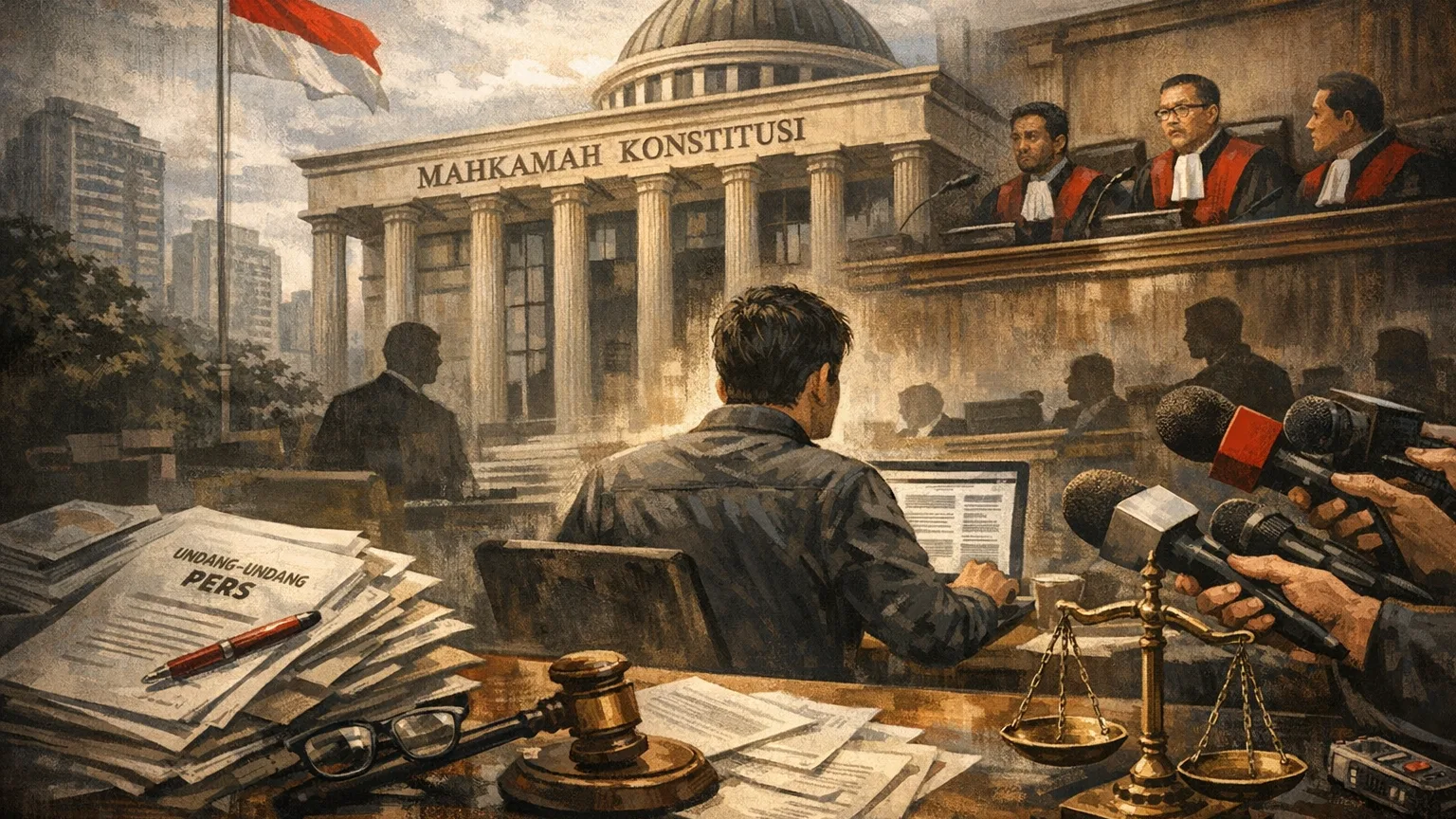
JAKARTA, Legal Literacy — The Constitutional Court (MK) rejected the request for a material review of Article 8 and the Elucidation of Article 12 of Law Number 40 of 1999 concerning the Press. In Decision Number 196/PUU-XXIII/2025 which was read out on Monday (19/1/2026), the Constitutional Court emphasized that columnists and/or freelance contributors still receive legal protection, both through the Press Law as long as they meet the criteria of a “journalist”, and through a number of other laws outside the Press Law.
Deputy Chief Justice of the Constitutional Court, Saldi Isra, stated that columnists and/or freelance contributors who fulfill the intent of Article 8 of the Press Law, namely carrying out journalistic activities regularly, being bound by the journalistic code of ethics, and being affiliated with a legal entity press company and carrying out their obligations legally, can obtain legal protection based on the provisions of the Press Law.


“Such regulation is not a form of discrimination or differential treatment before the law as argued by the Applicant,” said Saldi Isra in the decision pronouncement hearing in the Plenary Session Room of the Constitutional Court, Jakarta.
MK: Not Included in Article 8 Does Not Mean Without Protection
The Constitutional Court considers that the applicant's argument that places Article 8 of the Press Law as the only door to legal protection is not appropriate. According to the Constitutional Court, even if columnists and/or freelance contributors do not meet the criteria of journalists as intended by the Press Law, this does not mean that they lose legal protection in exercising their constitutional rights.
In considering the decision, the Constitutional Court stated that protection of the right to legal certainty, freedom of expression, and security remains available through a number of other regulations, including:
- Law Number 9 of 1998 concerning Freedom of Expression in Public,
- Law Number 39 of 1999 concerning Human Rights,
- Law Number 1 of 2023 concerning the Criminal Code (KUHP).
According to the Constitutional Court, this reference ensures that the exercise of constitutional rights relating to legal certainty, freedom of expression and self-protection continues to receive legal protection.
The Limit of “Journalistic Work”: Citizen Opinions Are Not Journalist Products
Apart from the protection aspect, the Constitutional Court also emphasized the distinction between “journalistic work” and community writing published in mass media. In the decision, the Constitutional Court explained that journalistic work is a product, content or work result of journalists who regularly carry out journalistic activities.
Conversely, writings by the general public—such as opinions, certain rubrics, and other forms of contribution—even though they have gone through an editor's curation process, are not automatically categorized as journalistic work. Consequently, such writings do not automatically become part of the responsibility of the press company as is the journalistic work accountability regime in the Press Law.
“Thus, works written by the general public, for example in the form of opinions, certain rubrics and others, even if they go through a ‘curation’ process from the editor, are not categorized as journalistic works so they do not become part of the responsibility of the press company,” said Saldi.
Background: Freelance Writers Request Expanded Protection
This request was submitted by freelance writer Yayang Nanda Budiman. The applicant is testing Article 8 of the Press Law and the Elucidation of Article 12 of the Press Law against Article 28D paragraph (1), Article 28E paragraph (3), and Article 28G paragraph (1) of the 1945 Constitution.
The applicant argues that Article 8 of the Press Law, which mentions journalists in a limitative manner, creates legal uncertainty regarding the status of freelance writers in the press ecosystem. According to the applicant, this condition has an impact on the non-fulfillment of the right to legal certainty, self-protection and security, and the right to express opinions.
In his petitum, the applicant asked the Constitutional Court to declare Article 8 of the Press Law conditionally unconstitutional as long as it is not interpreted to mean that “journalists, columnists and freelance contributors receive legal protection”. The applicant also requested an expansion of the interpretation of the Elucidation of Article 12 so that accountability includes not only journalistic works, but also “other press products” such as opinions, columns, letters to the editor, and advertisements.
However, the Constitutional Court rejected the request.
Implication of the Verdict: Professional Standards, Not Discrimination
Through this ruling, the Constitutional Court essentially affirms that the protection regime of Article 8 of the Press Law is inherent in the professional status of journalists who meet certain standards. Meanwhile, for columnists and freelance contributors outside the definition of journalists, legal protection remains available through other legal frameworks, so it cannot be immediately assessed as discriminatory treatment.



















Comments
0Share your perspective politely, stay relevant, and focus on the article. Comments appear after moderation.
Join the discussion
Write a clear, polite response that stays on topic.
No comments yet. Be the first to discuss.
Comments will appear after moderation.