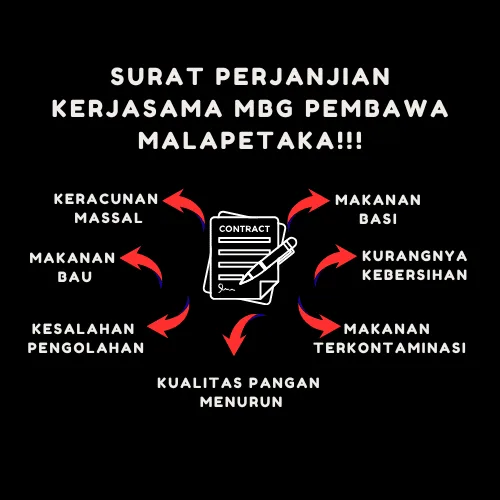
Legal Literacy- Please note that the Cooperation Agreement (PKS) in the Free Nutritious Meal (MBG) program has binding legal force. If any party feels aggrieved, this agreement carries serious legal consequences, where that party can file criminal charges or civil lawsuits to claim material and immaterial compensation.
As a case study, let's look at the agreement at SMPN 3 Wates Kulon Progo, Special Region of Yogyakarta, on Thursday, September 25, 2025. In the MBG cooperation agreement letter, point 7 reads:
"If extraordinary events occur, such as poisoning, incomplete contents in the food package, and other conditions that may disrupt the program, the Second Party (School) is committed to maintaining the confidentiality of information and resolving it amicably until the First Party (Triharjo Nutritional Fulfillment Service Unit) finds the best solution to resolve the problem. Both parties agree to communicate and cooperate in finding the best solution for the continuity of this program."
Legal Consequences of Detrimental Agreement Clauses
A cooperation agreement containing clauses to keep confidential, not disseminate, and resolve poisoning cases amicably has the following legal consequences:
1. Analysis from a Civil Law Perspective (Validity of the Agreement)
A clause that releases the food provider from full responsibility for losses (such as poisoning) is potentially null and void or can be canceled, in accordance with
Article 1320 and Article 1337 of the Civil Code (KUH Perdata).
- Contrary to Public Order: The health and safety of students is part of public order. Clauses that prohibit the dissemination of poisoning information and impose amicable settlements can be considered contrary to laws and public order. If it violates the condition of "lawful cause" (Article 1337 of the Civil Code), the agreement is null and void.
- Prohibited Standard Clauses: Based on Law Number 8 of 1999 concerning Consumer Protection (UUPK), clauses that transfer or release the responsibility of business actors for consumer losses are prohibited (Article 18 of the UUPK). Such clauses are automatically null and void.
Civil Law Conclusion:Although the agreement has been signed, clauses that are detrimental and violate the law do not have binding force. The school and victims still have the right to demand compensation.













Comments
0Share your perspective politely, stay relevant, and focus on the article. Comments appear after moderation.
Join the discussion
Write a clear, polite response that stays on topic.
No comments yet. Be the first to discuss.
Comments will appear after moderation.