
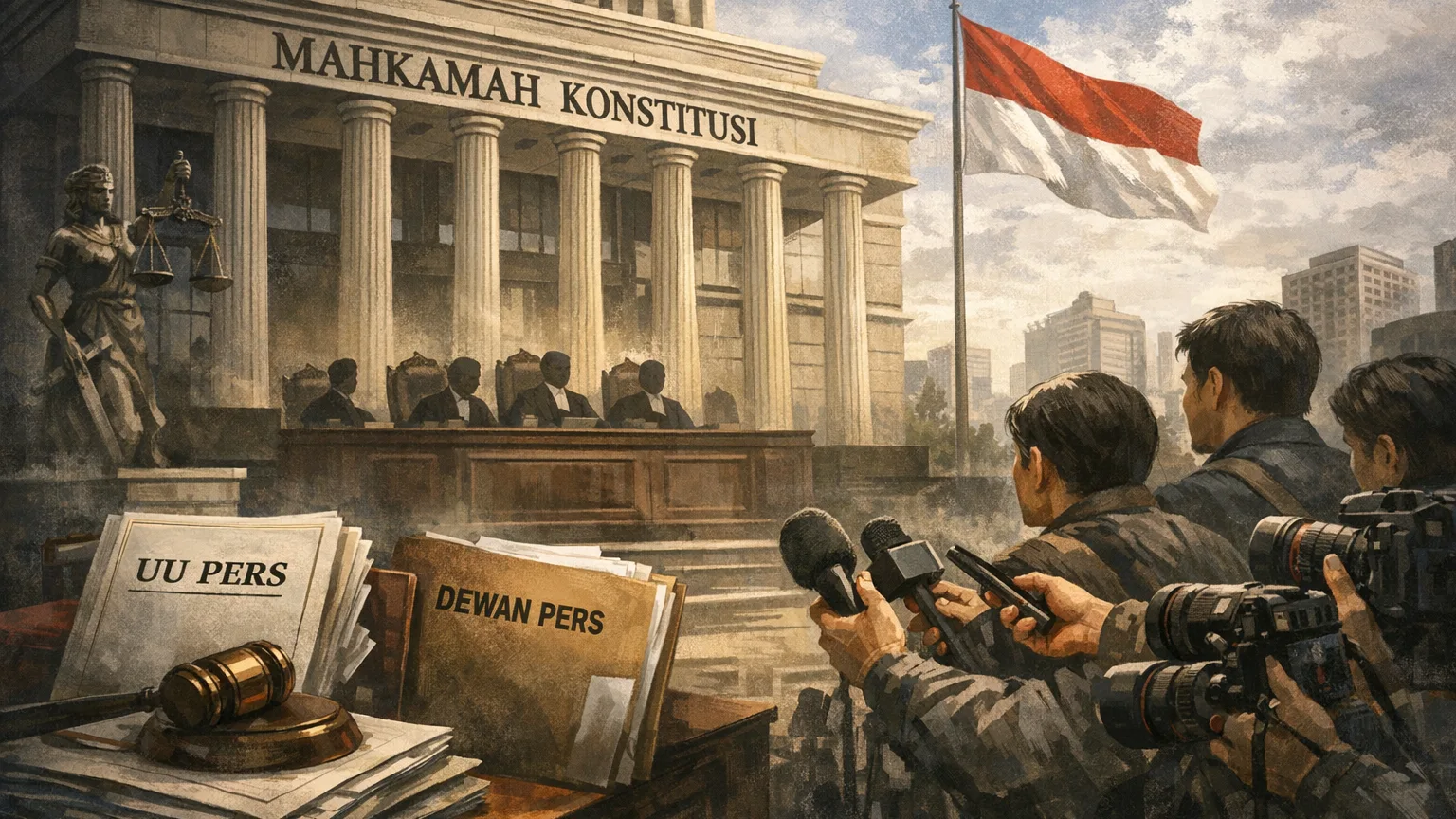
JAKARTA, Legal Literacy — The Constitutional Court (MK) affirms that providing legal protection to journalists is a constitutional instrument to prevent criminalization of the press and realize substantive justice. In Decision Number 145/PUU-XXIII/2025, pronounced on Monday (19/1/2026), the MK interprets the phrase “legal protection” in Article 8 of Law Number 40 of 1999 concerning the Press (Press Law) as a norm that must place the mechanisms of the Press Law and the Press Council as the main forum before the use of criminal and civil instruments.
The legal considerations of the decision were read by Constitutional Justice M. Guntur Hamzah. This case was filed by the Legal Journalists Association (IWAKUM) through its General Chairperson Irfan Kamil and Secretary General Ponco Sulaksono, who questioned Article 8 of the Press Law and its explanation because it was considered ambiguous and could create uncertainty in the practice of journalist protection.


MK Highlights the Risk of Criminalization of the Press
The MK assesses that the use of prosecution instruments, both criminal and civil, against journalists who legitimately carry out journalistic functions has the potential to lead to criminalization of the press. This condition is understood as the use of legal processes that can silence criticism, limit the flow of information, or suppress freedom of expression.
The MK also emphasized that journalists have an inherently vulnerable position (vulnerable position) because journalistic activities often intersect with political, economic, and social interests. Therefore, special and affirmative legal protection for journalists is not a privilege that violates the principle of equality before the law, but rather a constitutional instrument to realize substantive justice.
Conditional Protection, Subject to Code of Ethics and Law
The Court stated that legal protection for journalists is not absolute protection. This protection is conditional and subject to compliance with the journalistic code of ethics and statutory regulations. As long as journalists carry out their duties legitimately, the state and society are obliged to ensure that there are no arbitrary actions, including repressive actions, pressure, or intimidation that hinder press freedom.
In addition, the MK affirms that the functions, rights, obligations, and roles of journalists as referred to in the Explanation of Article 8 of the Press Law must be understood in their entirety as an inseparable unit from Article 8 of the Press Law. Journalists carry out press and journalistic functions to provide information, education, entertainment, and carry out social control, with the obligation to uphold truth, accuracy, and journalistic ethics.
Press Law as Lex Specialis, Press Council as Main Forum
In the decision's considerations, the MK places the Press Law as lex specialis which regulates journalistic activities, including press dispute resolution mechanisms. Therefore, Article 8 of the Press Law is not interpreted as impunity, but rather as substantive and procedural protection from repressive actions, criminalization, and disproportionate restrictions.
The MK emphasizes that in the event of alleged violence, intimidation, or criminalization related to journalistic work, criminal or civil instruments should not be used directly without first taking the mechanisms provided by the Press Law. The mechanisms of right of reply, right of correction, and ethical assessment of journalism by the Press Council must be positioned as the main and first forum (primary remedy), and even seen as part of the restorative justice.
In that framework, the use of criminal or civil sanctions against journalists is affirmed as a last resort (ultimum remedium). Law enforcement that ignores this principle is considered potentially threatening due process of law, disrupting the constitutional rights of journalists, and harming the public's right to obtain valid, accurate, and balanced information.
Verdict and Dissenting Opinion
In the verdict read by Chief Justice of the Constitutional Court Suhartoyo, the Constitutional Court stated that the phrase “legal protection” in Article 8 of the Press Law is contrary to the 1945 Constitution of the Republic of Indonesia and does not have conditionally binding legal force as long as it is not interpreted that the application of criminal and/or civil sanctions against journalists who carry out their profession legally can only be used after the mechanism of the right of reply, the right of correction, and alleged violations of the journalistic code of ethics based on consideration and settlement efforts by the Press Council does not reach an agreement as part of the application restorative justice.
Against this decision, three constitutional justices—Deputy Chief Justice of the Constitutional Court Saldi Isra, Constitutional Justice Daniel Yusmic P. Foekh, and Constitutional Justice Arsul Sani—expressed dissenting opinions (dissenting opinion) which essentially stated that the petition should have been rejected.














Comments
0Share your perspective politely, stay relevant, and focus on the article. Comments appear after moderation.
Join the discussion
Write a clear, polite response that stays on topic.
No comments yet. Be the first to discuss.
Comments will appear after moderation.