
JAKARTA, LITERASIHUKUM.COM — The polemic surrounding the embezzlement of savings funds belonging to Credit Union (CU) Paroki Aek Nabara, North Sumatra, has finally reached a resolution. Responding to public pressure and intervention from parliament, the management of PT Bank Negara Indonesia (Persero) Tbk has promised to fully return the funds amounting to IDR 28 billion, which were previously embezzled by the former Head of the BNI Aek Nabara Cash Office, Andi Hakim Febriansyah.
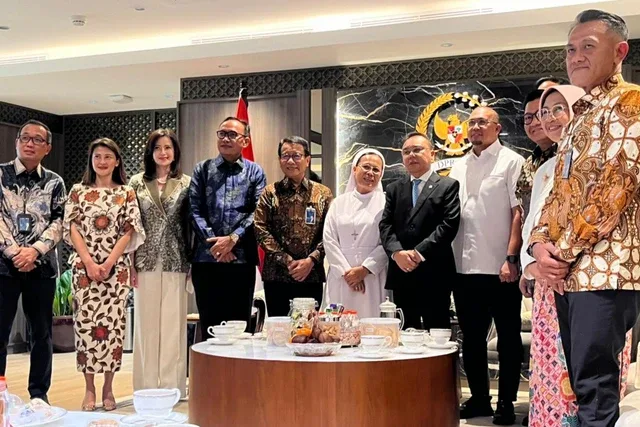
The agreement to resolve customer losses was reached during a mediation meeting initiated by the Deputy Speaker of the House of Representatives (DPR) RI, Sufmi Dasco Ahmad, at the Parliament Complex, Senayan, Jakarta, on Tuesday (21/4/2026). The strategic meeting directly brought together the President Director of BNI, Putrama Wahju Setyawan, and the Treasurer of CU Paroki Aek Nabara, Sister Natalia Situmorang. In the forum, the state-owned banking party guaranteed that the disbursement of restitution funds would be fully executed on Wednesday (22/4/2026).


Putrama Wahju Setyawan openly expressed his appreciation for the direct attention from President Prabowo Subianto towards the resolution of this case. He emphasized that the bank has formulated concrete solutions and secured liquidity to cover the losses due to banking crimes committed by internal individuals. The return of funds is guaranteed to be carried out one hundred percent in accordance with the legitimate financial records of CU Paroki Aek Nabara.
Absolute Corporate Responsibility and Supervisory Evaluation
In terms of banking law and consumer protection doctrine, BNI's step to bear the losses of customers due to an unlawful act committed by its employees is a form of fulfilling the principle of vicarious liability or corporate joint liability. Under the regime of Law Number 10 of 1998 concerning Amendments to Law Number 7 of 1992 concerning Banking, banking institutions are required to implement the principle of prudence (prudential principle) and guarantee the security of public funds entrusted to them. When fraud or fraud occurs by internal officials within the scope of their work, the bank bears a civil obligation to restore the rights of customers, regardless of the criminal process ensnaring the perpetrators.
This tens of billions scandal is also a stark warning for the governance of internal supervision of national banking. Putrama admitted that the incident at the Aek Nabara Cash Office was a slap in the face that required a thorough structural evaluation. In addition to promising to tighten the internal control system and mitigate the risk of white-collar crime at BNI, he also highlighted the importance of strengthening financial literacy for institutional customers to proactively monitor the movement of account mutations on a regular basis.
This quick action facilitated by the parliamentary leadership is expected not only to end the financial suffering of the Aek Nabara Parish congregation, but also to restore public confidence in the integrity and security of state-owned banking services.















Comments
0Share your perspective politely, stay relevant, and focus on the article. Comments appear after moderation.
Join the discussion
Write a clear, polite response that stays on topic.
No comments yet. Be the first to discuss.
Comments will appear after moderation.