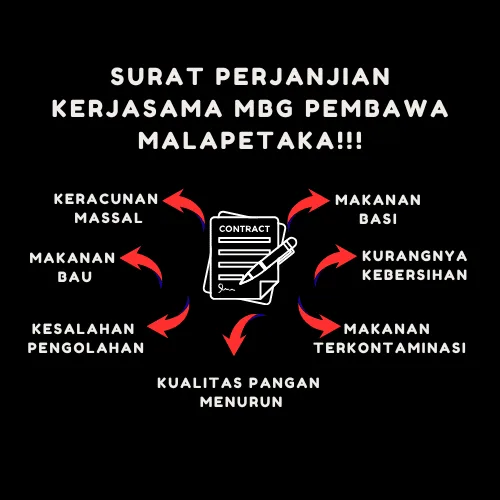
Legal Literacy - Please note that the Cooperation Agreement (PKS) in the Free Nutritious Meal (MBG) program has binding legal force. If any party feels aggrieved, this agreement carries serious legal consequences, where that party can file criminal charges or civil lawsuits to claim material and immaterial compensation.
As a case study, let's look at the agreement at SMPN 3 Wates Kulon Progo, Special Region of Yogyakarta, on Thursday, September 25, 2025. In the MBG cooperation agreement letter, point 7 reads:
"If extraordinary events occur, such as poisoning, incomplete contents in the food package, and other conditions that may disrupt the program, the Second Party (School) is committed to maintaining the confidentiality of information and resolving it amicably until the First Party (Triharjo Nutritional Fulfillment Service Unit) finds the best solution to resolve the problem. Both parties agree to communicate and cooperate in finding the best solution for the continuity of this program."
Legal Consequences of Detrimental Agreement Clauses
A cooperation agreement containing clauses to keep confidential, not disseminate, and resolve poisoning cases amicably has the following legal consequences:
1. Analysis from a Civil Law Perspective (Validity of the Agreement)
A clause that releases the food provider from full responsibility for losses (such as poisoning) is potentially null and void or can be canceled, in accordance with
Article 1320 and Article 1337 of the Civil Code (KUH Perdata).
- Contrary to Public Order: The health and safety of students is part of public order. Clauses that prohibit the dissemination of poisoning information and impose amicable settlements can be considered contrary to laws and public order. If it violates the condition of "lawful cause" (Article 1337 of the Civil Code), the agreement is null and void.
- Prohibited Standard Clauses: Based on Law Number 8 of 1999 concerning Consumer Protection (UUPK), clauses that transfer or release the responsibility of business actors for consumer losses are prohibited (Article 18 of the UUPK). Such clauses are automatically null and void.
Civil Law Conclusion: Although the agreement has been signed, clauses that are detrimental and violate the law do not have binding force. The school and victims still have the right to demand compensation.
2. Analysis from a Criminal Law Perspective
No civil agreement can eliminate or cancel criminal liability. Confidentiality clauses cannot prevent legal proceedings if a criminal act is proven to have occurred. Law enforcement officials (Police or Prosecutor's Office) are obliged to conduct investigations without being bound by the contents of the agreement.
Identification of Parties Who Can Be Held Accountable
Defendant in a Civil Lawsuit
The party that can be sued civilly to be held accountable is a third party, namely the food provider. The basis for the lawsuit could be:
- Default (Breach of Contract): The school or the student's parents can sue the food provider for failing to fulfill the obligation to provide safe and proper food.
- Unlawful Act (PMH): The victim (through the parents) can sue based on Article 1365 of the Civil Code, because the food provider's negligence has caused physical and material losses.
- School Responsibility: The school also has the potential to be sued if it is proven negligent in choosing partners or supervising food distribution, even though the main responsibility lies with the provider.
Potential Suspects in Criminal Law
The determination of suspects is based on the results of the investigation to prove the element of error (intentional or negligence). The regulations that can be applied include:
- Food Crime (Priority): Law Number 18 of 2012 concerning Food.
- Article 140: Prohibits the production/distribution of food that does not meet safety standards. The threat is a maximum imprisonment of 2 years or a fine of Rp4 billion.
- Article 141: Prohibits the production/distribution of food that is intentionally made dangerous. The threat is a maximum imprisonment of 15 years or a fine of Rp10 billion.
- Health Crimes and Negligence (Criminal Code):
- Article 204 of the Criminal Code: Intentionally selling goods that are dangerous to life/health. The maximum penalty is 15 years.
- Article 360 of the Criminal Code: Negligence resulting in serious injury to another person.
Responsible Party: The suspect will be directed to the party directly responsible for the processing and distribution of food, such as:
- Company Person in Charge: Director or operational manager of catering.
- Field Person in Charge: Head chef or employee proven negligent.
Thus, the party to be sued as the defendant (civil) and designated as the suspect (criminal) is the food provider and the individuals within it who are proven to be negligent or intentionally cause poisoning. This status is not affected by the contents of the confidentiality clause in the agreement with the school.
Recommendations and Mitigation Steps
Therefore, the parties must be careful and thorough when drafting and reviewing the draft agreement until the signing process. The school, such as legal analysts, administration, and leaders (principals, secretaries, treasurers, and MBG program managers), must play an active role. They need to understand every detail of the agreement carefully and completely so that they are not harmed in the future.
The clauses that need to be the main focus in this kind of agreement include:
- Scope of cooperation
- Rights and obligations of the parties
- Term of agreement
- Liability clause
- Default (breach of contract)
- Force majeure (force majeure)
- Sanctions, fines, and compensation
- Confidentiality of information
- Dispute resolution mechanism













Comments
0Share your perspective politely, stay relevant, and focus on the article. Comments appear after moderation.
Join the discussion
Write a clear, polite response that stays on topic.
No comments yet. Be the first to discuss.
Comments will appear after moderation.